Feed sync for people with too many feeds
A reader for people who own more than one kind of computer
You open the work laptop and the reading queue is still on the Mac. Or you crossed three hundred feeds and the free sync started losing articles. Lantery keeps one queue — on every machine, and in every app you read in.
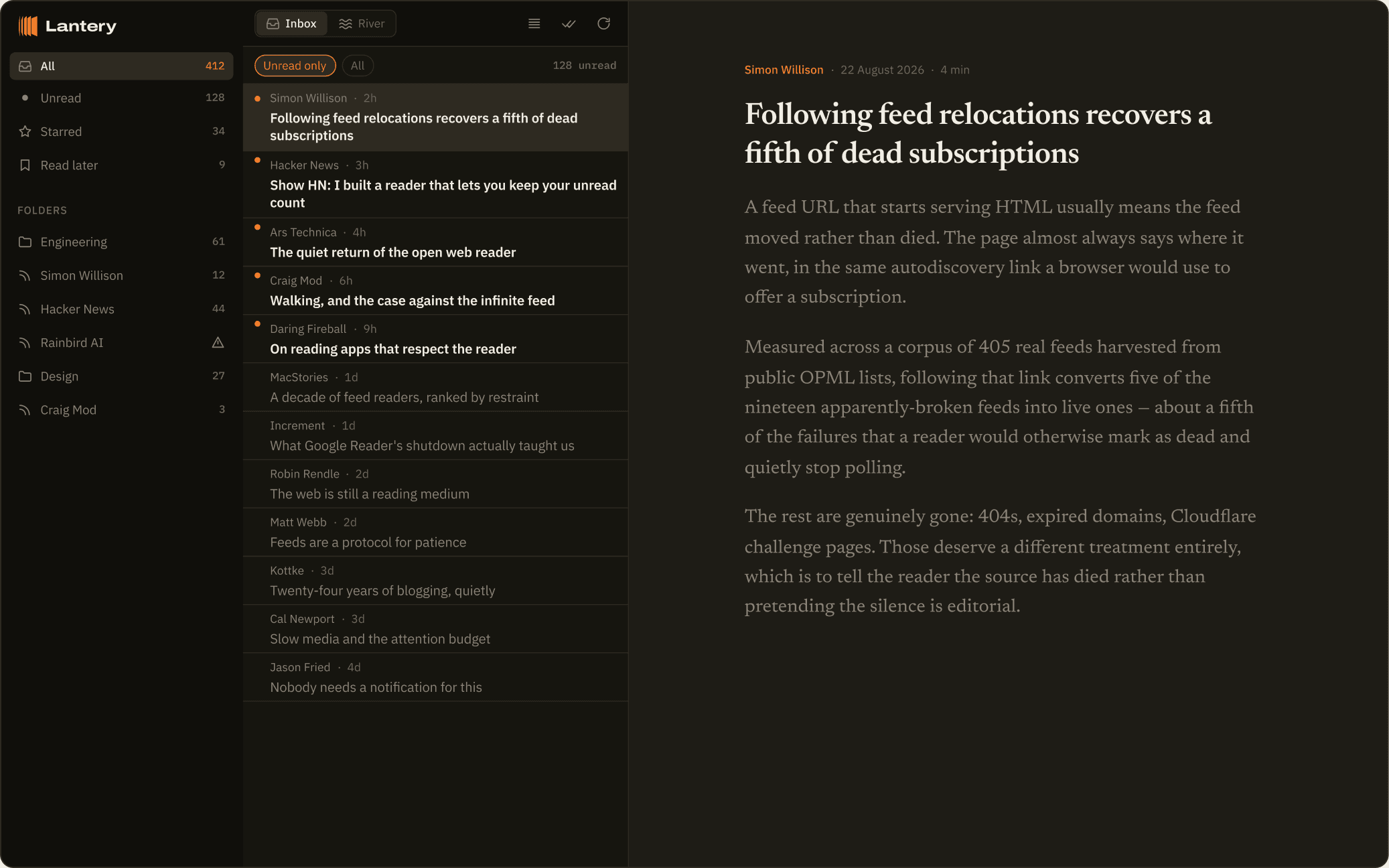
Inbox mode, dark theme, compact density. River mode and three densities are a setting, not a redesign.
If the word “feed” needs explaining
Most websites publish a machine-readable list of everything they post, called a feed (the format is known as RSS). A feed reader collects those lists so you see new articles from the sites you chose, in the order they were published, with no algorithm deciding what you see.
The hard part is not reading — it is synchronising. Read something on your laptop and it should not still be unread on your phone. That requires a server that checks every site on your behalf and remembers your place. That server is what Lantery is.
Built for the point where the free option stops working
Apple’s iCloud sync is free and fine, and it only ever worked on Apple devices. It also slows down as your list grows — NetNewsWire’s own FAQ says iCloud limits how much data it will send, so a big import can take a long time to land. If you read on a work PC, an Android phone or a Linux desktop, it was never an option at all
Unlimited feeds
No cap on the paid plan. The free plan holds 150 feeds, which is where most people start and where plenty of people stay.
Works in your current app
Lantery speaks the sync protocols existing readers already support, so you keep NetNewsWire, Reeder or Unread and point it at us.
Nothing silently marked read
Adding a site fetches its archive and leaves every article unread. Losing a backlog to a new subscription is a common complaint elsewhere.
Full-text articles
Sites that publish only a summary get fetched in full and rendered as clean, readable text, without the page furniture.
You are told when a source dies
Feeds move house and quietly break. Lantery follows a feed that has moved, and says plainly when one has actually stopped.
Export is always free
Your subscriptions and data are exportable on every plan, including after a subscription ends. Leaving should be as easy as arriving.
Status
Lantery is in development. The service that fetches and synchronises feeds is built and running; the reading apps and the sign-up flow are not open yet. Leave an address and you get one email on the day they open — no sequence, no newsletter, and nobody else sees it
One email about the launch, nothing else, no third parties. Ask us to delete the address at any time — privacy policy.
$45 a year, everything included
Compared against the other services that also run their own servers to fetch your feeds
| Service | Price | What you get for it |
|---|---|---|
| Lantery | $45/yr | everything included, on every device |
| Feedbin | $70/yr | sync only, no apps of its own |
| Feedly | $84/yr | Pro+, billed annually |
| Inoreader | $90/yr | Pro, billed annually |
| Readwise Reader | $120/yr | approximate |
There are cheaper readers, and there are free ones. They sync through Apple’s iCloud, which costs them nothing and works on Apple devices only. If that fits how you read, use one of those — they are good.