How many RSS feeds is too many?
Someone asked who could possibly be subscribed to more than 100 feeds. In the replies, one person had more than 600, another had 1,146, and another had over 2,000.
The person with 600 said many of their sources might never post again. They kept them anyway. If one did come back, RSS would tell them. That is a useful reason to keep a subscription, even if it sits quietly for years.
The exchange comes from a discussion about why people pay for RSS readers. I am building a feed reader and sync service, so I have a stake in the answer. Those comments are individual examples, not a survey of how many feeds people normally follow.
There is no universal number at which a feed collection becomes too large. Look at how many items arrive, whether you can find what you want, and whether your reader can keep the collection up to date. A plan's subscription cap is a separate constraint.
A subscription is not a daily assignment
Some feeds publish every few minutes. Others belong to a writer who posts twice a year, a local venue that announces events when it has them, or a small project whose last update was a long time ago.
In another discussion about feed counts, a reader with around 500 subscriptions described keeping infrequent sources alongside a much smaller number of high-volume news sites. The infrequent feeds saved them from checking hundreds of quiet pages by hand.
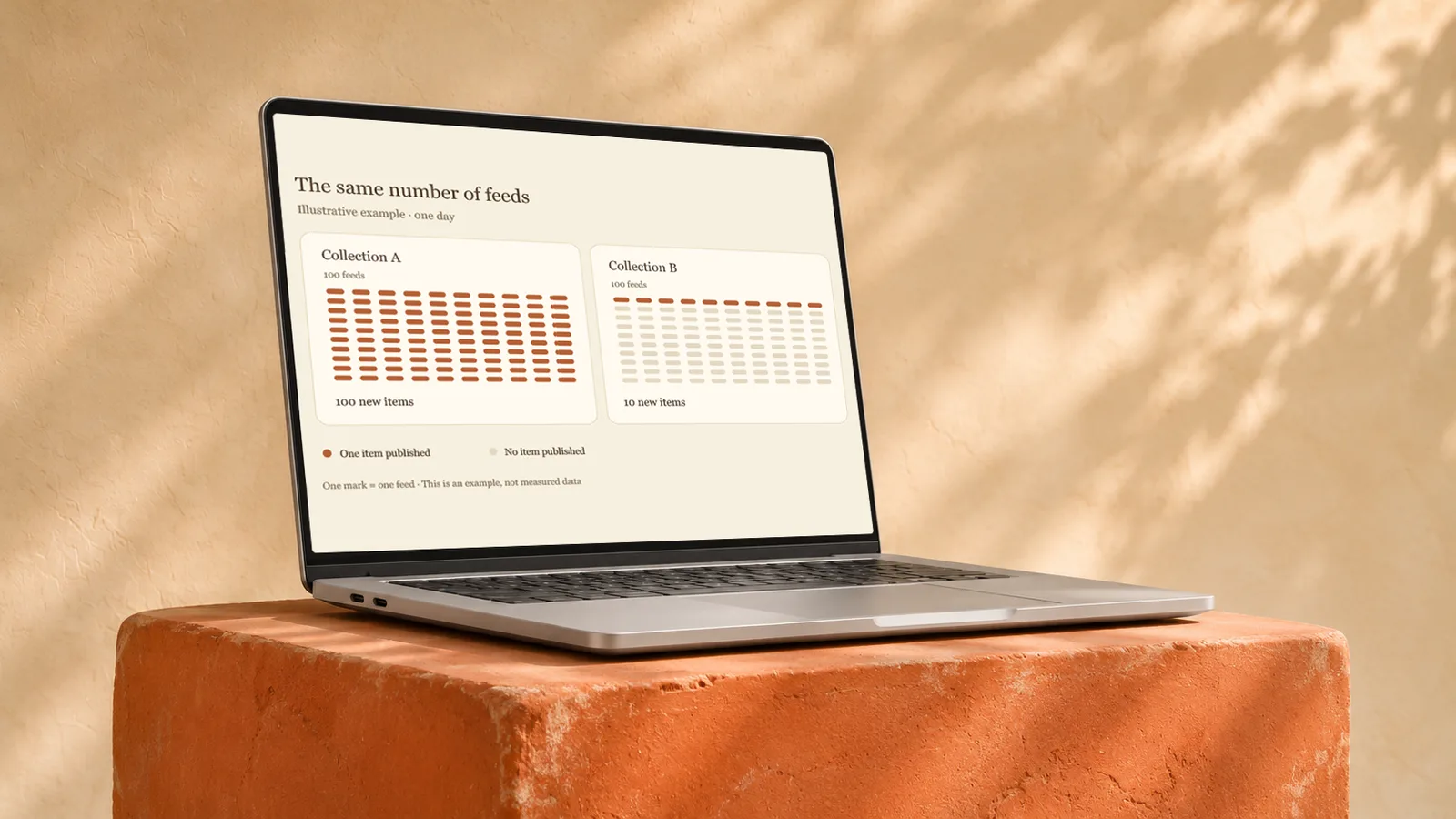
That distinction changes the arithmetic. Imagine two collections, each with 100 feeds. In the first, every source publishes one item a day: 100 new items. In the second, ten sources publish one item a day and the remaining ninety publish nothing that day: ten new items. Those are invented examples, not measured averages. They show why a feed count cannot tell you the size of a day's reading.
A quiet subscription still has a job. It remembers a site you do not want to visit every morning just in case something changed. In the first discussion, one reader with more than 600 feeds said they kept inactive sources so they would hear about a new post without checking each site.
The limit you notice first may be the plan
A feed cap is easy to see: add one more source and the reader asks you to remove one or pay. That does not mean your collection has reached a technical limit. It means this particular plan has a boundary.
The examples below are deliberately small. Prices and limits change, and a free application is not the same product as a hosted service that fetches and syncs on your behalf.
| Service | Free option | Paid option | What to check |
|---|---|---|---|
| Inoreader | 150 RSS subscriptions | Pro lists 2,500 RSS subscriptions; $7.50/month billed annually or $9.99 monthly | Other source types and features have separate limits; tax can depend on location |
| Feedbin | 30-day trial; no permanent free tier is listed | $70/year or $7/month | Its pricing page does not state a feed limit; do not assume unlimited from that omission |
| NetNewsWire | Free, open-source reader for Mac, iPhone and iPad | The app is free | Check the terms of any separate sync service you choose to connect |
Vendor pages checked 7 November 2026. Prices may vary with taxes or change. A trial is not a free ongoing plan.
A free cap matters when your collection exceeds it, even if most of the feeds are quiet. But the cap is only one part of the decision. A person with 80 high-volume sources may care much more about filtering than someone with 600 occasional ones.
Find the actual bottleneck
Before deleting half your subscriptions, look at what is going wrong.
Too many new items? Find the handful of sources that publish most often. If your reader offers per-feed settings or filters, try those before removing quieter subscriptions. Some sources provide narrower feeds for particular topics; those can be a better fit than the publication's main feed.
Old items disappearing? Check the reader's history and retention rules. A subscription list and an archive of articles are different things. Keeping a feed does not necessarily mean the service keeps every article forever.
Devices disagreeing? Check which accounts the devices use and whether they have finished syncing. A count by itself cannot establish why a sync is slow or whether any items were lost. Do not delete the old account until you have checked the new one.
Updates arriving late? Look at the service's refresh settings and the individual source. Publication time, feed availability, polling and sync can each affect when an item appears. The remedy depends on which step is slow.
A source looks dead? Open its site before removing it. It may have moved, changed its feed address or simply stopped publishing for a while. If you still want to know when it returns, keeping it is a reasonable choice.
You can prune without starting over
If the collection has stopped being useful, you do not need to audit all of it in one sitting. Start with the noisy sources you notice every day. Move occasional sources into a folder you open less often. Remove subscriptions you know you no longer want.
Export an OPML copy before a large cleanup or a move to another service. It is a list of subscriptions and folders, not necessarily a backup of saved articles or read state. Check what your current reader exports separately.
Prune when it helps you find what you want. Keep the quiet sources if you still want to hear from them.
Where Lantery fits
I am building Lantery as a sync service with a reader, and it is currently in alpha testing. The published pricing page describes a free plan with 150 feeds and a paid plan with no feed cap. Public sign-up is not open yet. Those are our own choices, and they belong in the open in an article about limits.
If your collection fits a free reader and it works on the devices you use, there is no reason to move just because your list is large. If it does not, start with the specific thing that is missing: the number of sources, the reading interface, history, filtering or sync. Then choose the tool that handles that job.