What happens to your feeds when I disappear
In your place I would want one thing settled before anything else, and it would not be how the sync works. It would be what happens to years of collected subscriptions when the one person running this gets bored, takes a job, or dies.
That is a question about risk. Reassurance is a poor answer to it, so this is the whole business written down instead: what I hold about you, what the money is for, what I will not do, and what I have already got wrong in public.
Lantery is one person working part-time, roughly 20 focused hours a week, registered as a sole proprietor in Georgia. There is no team behind the singular.
What Lantery holds about you
Your subscription list, and a per-article record of whether you opened it. Both tied to the email address you sign in with.
Those records are what make sync work: without knowing which account owns a subscription or an article's state, the server cannot hand the right state to your next client. They also amount to a list of what you follow and what you chose to read. I am not going to call that "usage data".
Lantery is not a privacy tool and is not sold as one. A feed collection can represent years of decisions about which writers and publications deserve your attention, and article-level state records part of how you actually used it. Naming both is worth more than a sentence about how seriously I take your privacy.
I do not sell reading data. Holding it in order to sync it does not quietly become a second business.
What it costs to run Lantery
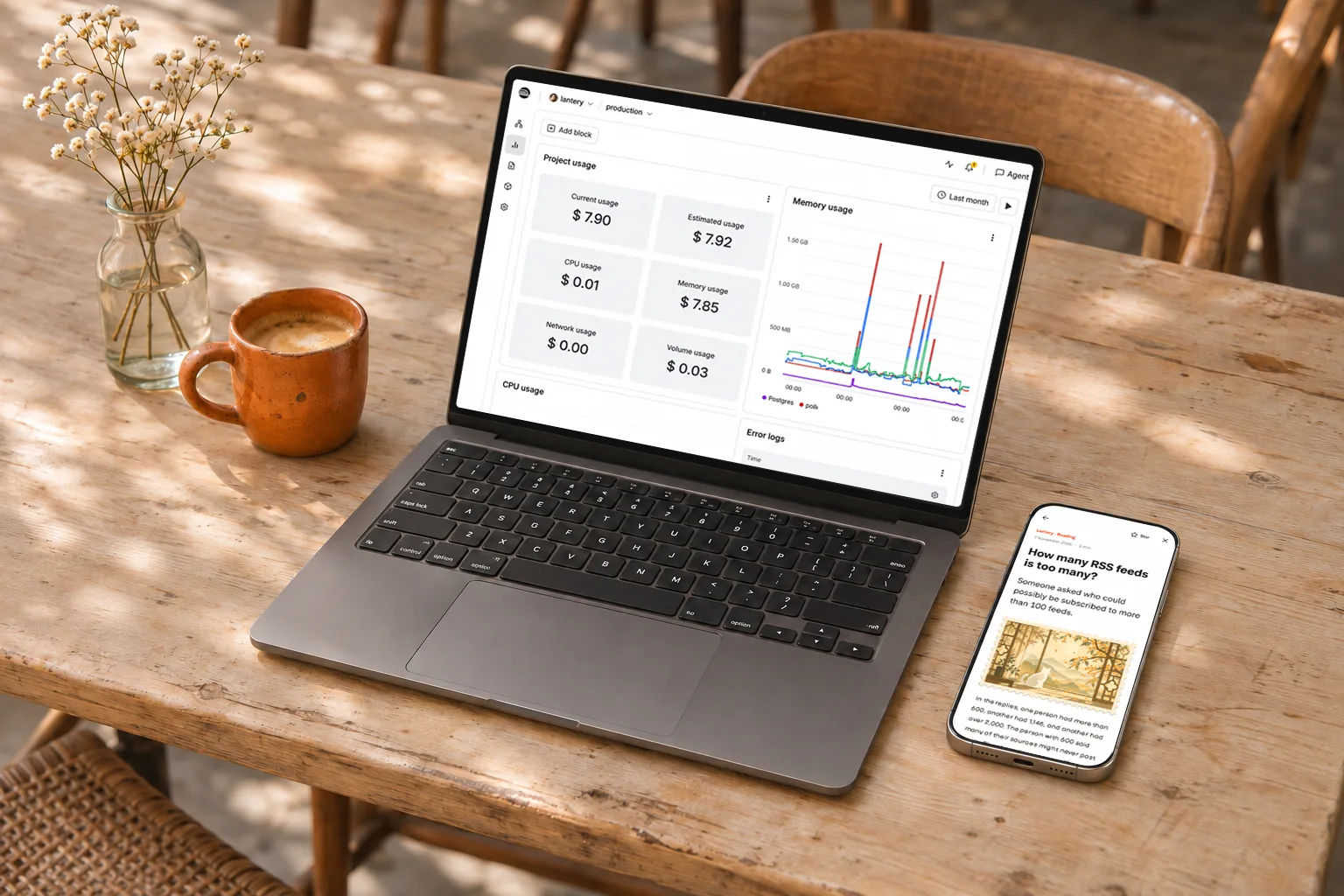
I want you to know what it costs to keep the service running when you trust it with your collection. So I will show the project's usage separately from forecasts and planning estimates.
For the 30-day window from October 1 to October 31, Railway showed $7.90 in current usage for the Lantery project. Memory accounted for $7.85, CPU for $0.01, volume storage for $0.03, and network for $0.00. The same view showed $7.92 in estimated usage. That second number is a forecast, not money already used.
This is a usage reading for the selected 30 days, not a closed monthly invoice. Costs can change with load and the number of users; one reading cannot predict what the service will cost in the future.
I previously published estimates of $33 and $7 a month. Both were projections rather than verified actual costs. I am correcting them here, and I will give the period and source when I publish a number.
The infrastructure is shaped around this workload. Railway bills per resource-second of actual use rather than per invocation. Feed polling is continuous, high-fan-out I/O: the server waits on many publishers at once, receives small responses, and repeats. Per-invocation pricing charges again for every one of those requests.
Where the $45 goes
The paid terms are $45 a year or $5 a month. Servers are the cheap part of this, which raises the obvious question of what the year is buying.
It is buying the part that does not get cheaper: one person answering support inside a day, working out why a feed broke after a publisher changed its output, and keeping the thing alive after the interesting engineering is finished. Those hours cost the same whether the server bill is thirty dollars or three.
Roughly 533 subscribers at $45 a year produce $2,000 a month gross, before fees and tax. That is the point where the time has a business behind it rather than being financed out of other work. It is a count, not a forecast — you can judge for yourself whether it looks reachable.
Below that number the difference comes out of my own pocket. I would rather you knew the threshold than took my word that things are fine.
Export is free, permanently, whether you pay or not
You can export at any time: on the free plan, while paying, after cancelling, and after the paid period ends. Having an active paid subscription is never a condition of getting your data out.
Feed subscriptions and folders come out as OPML. Read state, starred and saved articles come out in an open format. Export is a button in the product, not a request I process by hand. It does not need an active paid plan, a support ticket, or a conversation with me.
That last clause is the whole point. I cannot make my own continued existence certain, and any promise that I could would be worth nothing. What I can do is make the exit work without my cooperation. Your collection belongs to whoever assembled it, and holding it hostage is not available to me as a sales tactic.
What I will not do
No ads. Charging for the service directly is what keeps your attention from becoming inventory.
I will not turn your reader into an endless feed that pushes unrelated content to keep you scrolling. In Lantery, you choose the sources and receive posts from the writers and publications you follow.
The main Facebook and Instagram feeds mix recommendations with posts from accounts you follow. I prefer a different approach: if you have not followed a source, its posts should not appear in your feed unless you choose to add it.
No AI as the pitch. I pulled 774 negative reviews across eight feed readers; eleven mention AI at all, eight of those are attacks on it, and exactly one asks for AI that works better — written by a user of a product already built around it. Recent reviews skew negative, so treat that corpus as direction rather than a share of anybody's user base. Within that limit it gives me no reason to put AI at the front of this.
No investors, and therefore no outside growth target that would later require me to retrofit ads, an AI story, or a second use for your reading data.
These are checkable against what the product does, which is the only kind of commitment worth writing down.
If I stop
If I decide to close Lantery, I will give ninety days' notice by email. I will stop subscription renewals when the notice goes out. The service will keep running until the announced closing date, and every account will retain access and free export until then, regardless of when its paid subscription ends.
The ninety days are a notice period, not a special free subscription period. They are enough to see the notice, pick something else, export, and confirm the export actually opened. It is a clock and a delivery channel, both of which I can operate alone. I have deliberately not promised anything that needs a second person.
What exists today, and what does not
The sync service is built and running. It speaks the Google Reader API. NetNewsWire has signed in and completed a full sync in my testing; I will name other compatible clients only after I have run them myself rather than reasoned about them.
Lantery is currently in alpha testing. The reading apps and sign-up flow are not publicly open. Saying "there is a reader" while nobody can register for it would be the kind of claim this page exists to avoid.
There are no native apps of my own, and there may never be — clients that already exist do that job better than I would.
There is no browser extension.
The prices, free plan, trial, renewal, cancellation, and refund terms are published. Public registration is still closed. Those two facts can coexist: the commercial terms are written down, but I am not claiming that a public customer has completed payment.
Under-promising here is the only thing that makes the rest of this page worth anything.